UpGlobal Partners With State Department, Google Doubles Down

Up Global, Google for entrepreneurs, startup weekend, startups

October is a big month for UpGlobal, the new entity created when Startup America and Startup Weekend merged back in May. Next week UpGlobal will hold its first regional Champions Summit under the new umbrella. Since its formation, Startup America held quarterly summits for their regional champions. Now, after taking the summer quarter off, the two days of best practices, town halls, and networking continue. This time around they will incorporate Startup Digest curators and Startup Weekend leaders when the conference opens next Tuesday in Iowa.

Leading up to the big summit, UpGlobal had two major pieces of news that will help further their efforts to empower entrepreneurs and their communities around the world.

The first is a partnership with the US State Department, formally announced by President Barack Obama in a videotaped address he made to the attendees of the Global Entrepreneurship Summit in Kuala Lumpur, Malaysia.  ” In partnership with Up Global, we’ll help support 500,000 new entrepreneurs and their startups around the world,” President Obama told the audience.

UpGlobal oversees these four key initiatives to help grow entrepreneurs across the globe.

  • Startup Weekend:  A 54-hour event that educates aspiring entrepreneurs by immersing them in the process of moving an idea to market.
  • NEXT:  A five-week course for early-stage startup founders to better understand their product or service, become ideal candidates for accelerators or incubators, and fully integrate proven entrepreneurial methodologies.
  • Startup Digest:  The world’s largest curated source of information, news, and resources for anyone interested in entrepreneurship.  All content is tailored to reflect the local community, and subscribers receive a personalized digest each week.
  • Corporate Connections:  A platform that builds connections between startups and corporations based on shared goals and industries.  The platform allows startups to develop corporate partnerships, mentoring relationships, client and vendor relationships, and licensing opportunities in new and meaningful ways.

UP Global will work with the U.S. State Department, with the help of the Department of Commerce and USAID, to bring programs like these to new corners of the planet, tailor them to the needs of specific communities, and help secure the resources and network to bring these efforts to life.  This collaboration will help achieve the objective of doubling the reach of entrepreneurship programs and resources by 2016 by:

  • Connecting:  UP Global and the State Department will work together to help establish new UP Global chapters in 500 new countries and augment existing resources available to aspiring entrepreneurs.
  • Leveraging Networks:  The State Department will draw on its extensive networks in target countries to bring in local business leaders and prominent American entrepreneurs to reinforce UP Global’s programs and events.
  • Drawing attention to the cause:  UP Global and the State Department will coordinate to get information out about the entrepreneurship resources available through UP Global, including, when appropriate, through social media channels and outreach to local press.

The next big news for Seattle based Up Global was that Google, who has been partnering with Startup Weekend since last year through their Google For Entrepreneurs initiative, has doubled down and taken over as lead sponsor for Startup Weekend.

Upstart Business Journal said:

“…the Google partnership is especially powerful for the financial and technical support it can provide. UP is one of over 70 organizations that Google for Entrepreneurs has provided assistance to since formalizing a year ago. The entity within the search giant has been ramping up in recent weeks, announcing a new Google Hub network in seven non-coastal cities and plans to grow it to more.”

Google has replaced the Kauffman Foundation as the lead sponsor of the organization.
Find out more here and here.


CB Insights: Silicon Valley Is The Only Relevant Market For Venture Capital


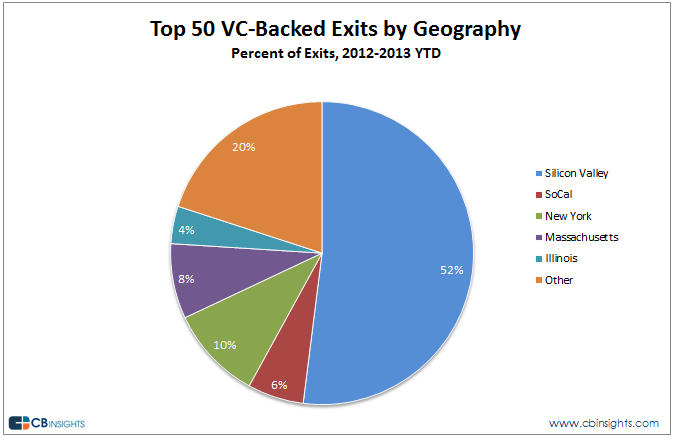
VCstory2Top research firm CB Insights released some very relevant and interesting data last week. The firm has been diving into their VC data to better understand fund performance and syndicate. In what they call one of their “more polarizing” briefs, they revealed that even today Silicon Valley is the most relevant market for venture capital. Silicon Valley is still producing the most exits.

Their latest data, measuring deal flow across the country, Silicon Valley still represents 52% of VC backed exits, leaving “everywhere else” with an improved, but still less, 48%.

VC, Silicon Valley, Everywhere Else, Rise Of The Rest, Everywhere Else Conference

When purely looking at the value of exits, Silicon Valley is still far ahead of everywhere else. When CB Insights analyzed the valuation of the top 50 exits in the country Silicon Valley companies accounted for 86% to the top aggregate exit valuations of those top 50 exits. In 2012 Facebook’s IPO accounted for a tremendous chunk of the 86% but once removed Silicon Valley still accounts for 54% of the aggregate exit valuations.

New York, Southern California, Massachusetts and Illinois trail behind Silicon Valley.

There are even investors who believe that New York is a waste of time.

CB Insights reports that at a recent dinner in NY hosted by Silicon Valley firm Lowenstein Sandler one VC said “New York is an irrelevant market for us as a venture capital firm. They went on to say that from the investor’s perspective allocating his firm,s time to New York or any other market outside of Silicon Valley was a waste of time.

But there’s hope.

Late last month AOL founder Steve Case announced that his Revolution Venture Fund had raised $200 million dollars that they were specifically going to use to back companies everywhere else. Case’s big mantra is “Rise of the rest,” and that is exactly what’s going on now.

There have always been investors and startups everywhere else. One of the fundamental problems we’ve found since launching Nibletz and the Everywhere Else conferences is that entrepreneurs and investors exist everywhere. The problem lies in the fact that the entrepreneurs believe that it’s best to move to Silicon Valley or in some regards New York City to grow their company. At the same time the investors either don’t know that there are good deals in their own neighborhoods or it’s just flashier to find an investment in a larger city or participate in rounds with Silicon Valley.

Investors like Mercury Fund’s Blair Garrou, Dundee Venture Capital’s Mark Hasebroock, and Drive Capital’s Mark Kvamme all see the value in finding startups worth investing in everywhere else, thus contributing to the rise of the rest. These investors are not alone. At our recent Everywhere Else Cincinnati conference, we had over 40 investors from across the country that represented over $1 billion dollars in deals across Everywhere Else. (Note we still consider New York Everywhere Else and obviously many others do too.)

Events like Big Omaha, Big KC, UpGlobal’s startup summit, and the Everywhere Else Conference Series all unite entrepreneurs from everywhere else to continue developing their own market.

The notion that innovation only happens in Silicon Valley is quite ridiculous. Cars were invented in Detroit. Air planes were invented in North Carolina (some may dispute that). The overnight package was invented in Memphis, Tennessee. In the overall landscape of things, everywhere else far outweighs the rest of the country as far as large corporations being founded and continuing to produce.

Some Amazing Tips To Make Board Meetings Suck Less

Board room, board meeting, board members, startups

When should your startup have a Board of Directors? That’s a question that many young startups either ask, or at least pretend they know the answer to. First off until you have venture money on board, a Board of Directors isn’t necessary. You may choose to assemble an advisory board, but it’s typically when you get VC’s to the table that they want to have a formal seat at it.

Now you may run into an angel that gives you a big chunk of seed money and wants to get on your board. When you decide to take that money you want to also make sure you want that particular angel involved in your decision making process. You may want to pass on that angel and find someone who will let you grow to a series A round before adding decision makers into your company.

Rule number one in this case is very important:

Investment and Equity does not necessarily = board seat.

We will dive more into the board in another post, but as a general rule of thumb, once you start adding a board of directors, you’re not the only one calling the shots.

Of course the opposite also holds true. You may know someone, an investor or not, that strategically makes a lot of sense for your business. You may also have someone that adds clout to your board. In that case you may want to add them to your board, but again take into consideration what that means for your startup.

First Round Review, First Round Capital’s blog for entrepreneurs and by entrepreneurs, took a really good look at “The Secret To Making Board Meetings Suck Less.”  Jeff Bonforte co-founder of Xobni which sold to Yahoo, Mike Maples CEO of Floodgate, Dan Rosensweig CEO of Chegg, and Nirav Tolia all weighed in on this important discussion.

Once you have a board of directors you have to have board meetings. Those can be extremely intimidating for almost any entrepreneur turned CEO. If you’ve been an entrepreneur all of your life or left a traditional “job” to become an entrepreneur your first board meeting may feel like you have bosses, because you do.

“Board meetings are the height of insecurity for a CEO. Basically it’s a group of people who can both judge you and fire you based on that judgment,”  Bonforte told First Round Review.  Bonforte found that board meetings at his previous startup iDrive were nerve racking and that was stemming from the fact that his board was constantly criticizing and “attacking” him. He decided that from then on he would find board members vested in helping him rather than attacking him.

Bonforte gives these reasons that board meetings typically suck:

  • Board meetings are long, grueling, and hard to focus.
  • It’s nearly impossible to capture your company’s story accurately when you’re obligated to only talk about certain things, i.e. how money’s getting spent.
  • You can’t always get who you want on your board. Sometimes you have a choice, but most of the time one or two members will not have been your first pick and there’s nothing you can do about it.
  • Too many boards are too big, and too many board members invite observers and general hangers on — all who want to chime in with something to sound smart.
  • If you present a deck from the front of a boardroom, you’re asking to be judged and picked apart. It’s like you’re pitching your company all over again, only this time to people who can take it away from you.

The single biggest take away from Bonforte on all of this is:

“Every single entrepreneur forgets that the board works for them,” Bonforte says. “They’re in meetings getting their asses kicked and walking out with even more work to do. They feel like they have to prove their vision instead of proving that everyone in the room should be working together to solve the problem. As the CEO, you feel like it’s your job to carry the ball across the line, but it’s also the board’s job too.”

Bonforte and the other CEO’s offer some great, and some very simple, tips to making board meetings suck less like, don’t stand up and don’t do your deck from the front of the room.
Check out the rest of this important information at First Round Review.

J.D. Power’s 10 Things I’ve Learned in Business

JD Power, Guest Post, Startup Tips, Business lessonsBy James “David” Power III

  After fifty years working with a range of companies—as well as founding and running my own company, J.D. Power and Associates—I have observed a good deal, and come away with a few thoughts about how to have the best shot at success in business.
The businesses I’ve seen grow, adapt, and thrive are the ones that keep a focus on satisfying customers by listening to them, anticipating their needs and desires, and maintaining their organizations’ prioritizing of these principles.
Whether I’m speaking with business school students or seasoned executives, I find that my advice incorporates ten basic lessons I’ve learned throughout my career.
1. Listen—to your customers, your employees, and your stakeholders. 
I have witnessed too many car manufacturers move further away from achieving satisfied customers by refusing to listen to them. One example that sticks in my mind is that of Peugeot back in the 1980s. They were trying to broaden their appeal and expand their share of the American car market, but they were unwilling to listen to customer complaints about difficulties starting their advanced fuel-injected cars. Peugeot was an early adopter of fuel injection, and American customers were “flooding” the engine by pumping the gas, something that was necessary in conventional engines at that time. Customers saw this as a quality issue, but rather than hearing this as a problem, they held fast, confident that fuel injection was superior from an engineering standpoint. No doubt they were right, but by not listening and adapting to their customers they lost them, and by the early 1990s they had to abandon the American market.
2, Remember who the client is. In a B2B world it is the organization or business you serve, not just the guy or gal sitting across from you.
This is important from two perspectives. It is critical that you not serve the desires of the representative assigned to work with you to the disservice of the organization. On the flipside, you must feel empowered to not let that person become an obstacle to the organization receiving the information necessary to take full advantage of your services. I frequently encountered a situation where the person assigned to work with us put up roadblocks to information reaching further up the chain of command because it undermined his own position within the organization. I worked around this by sending letters directly to top leaders or using the press to get out the critical information, knowing that it was only when our message could not be ignored that true change for the organization could occur.
3. Empower your employees to be curious, to do the right thing for the business, to speak up. You need the right kind of leadership and a strong culture to make it work but there is nothing more valuable.
At J.D. Power, if an employee came up with an idea, they owned it. This engendered tremendous initiative and loyalty, and may have been one of the greatest keys to J.D. Power’s lasting success.
4. Relationships matter, but they need to be built on a bedrock of respect and trust, not just friendships.
I never approached business relationships as requiring glad-handing or wining and dining. In the beginning, I simply couldn’t afford it, but as J.D. Power’s success widened, I found that true relationships with executives came from providing them with the clear, actionable information they needed to do their jobs, not time on the golf course.
5. Have empathy, be kind.
Of course this applies to all of the individuals in your own organization who come together to provide the support you need to run your business—from your CFO to the cleaning crew. It’s a Golden Rule in my book. I found that it inspires employees to show that you care about them enough to acknowledge them, and ask about their families. Another example is with regard to my clients. Sometimes I didn’t agree with what they were doing, or I knew that they were in an unwinnable position. I felt a compassion for them and always tried to make sure that our information was there to help them.
6. Be willing to look at situations from unusual directions to seek the “truth.”
Don’t be afraid to take a counter-intuitive position in order to generate better ideas. The Jesuit education I received at the College of the Holy Cross provided a basis in questioning the status quo, a trait that has served me well.
7. Accept change.
I really believe that you need to anticipate changes, be flexible, and move with the trends. We are in the Information Age today. The rise of the Internet and its impact on retailing is the most recent example of the ways companies must adapt in order to survive, but there has never been a time when change was not actively underway.
8. Stay true to your values.
Part of your brand is what you are—and, at the core, what you are is made up of your values. Whether you are an individual or an organization, you must keep your compass aligned to the virtues that guide you. At our company, I really felt that we kept the organization focused on the “Three I’s”: Independence, Impact, and Integrity.
9. Find information and inspiration in the work of others.
I have long been a student of the writings of Walter Wriston, Peter Drucker, W. Edwards Deming, and Alvin Toffler. Their observations are still compelling today, as are myriad others who can offer insight and perspective that will be invaluable to your pursuits.
10. Don’t “torture the data till it confesses.”
Don’t be blind to all but the good news you may want to hear. Consciously or unconsciously interpreting information that comes across your desk in a way that supports past decisions rather than illuminates needed improvements is short-sighted and won’t bring you closer to the satisfied customers who will ultimately dictate your success.
These ten principles guided me through a successful and satisfying career. The individuals I dealt with who shared a similar view of business invariably had the respect of clients and colleagues, and the markers of success were realized for them as well.
Dave Power is the founder of J.D. Power and Associates. Stories from fifty years in the auto industry are shared in the new book, Power: How J.D. Power III Became the Auto Industry’s Adviser, Confessor, and Eyewitness to History. For more information, visit www.davepowerbook.com.

Should You Really Be Giving Startup Advice [INFOGRAPHIC]

Today it seems like everybody has startup advice. Should you be listening to mine? Well that’s certainly up to you. In fact it’s always up to you who you decide to listen to and who you don’t. However there are a lot of people out there giving startup advice that may not be qualified to do so.

While nobody should just be classified into groups or stereotyped, here are some folks I am wary of. Also, I do have manners so I do at least listen to anyone who can break me of my ADD and actually captures my attention.

Small business and executive coaches with little or no references.

Small businesses are great. They impact the local economy the way startups would like to. They also permeate with an older, more traditional crowd than most startups can. A good friend of mine Pam Cooper, the founder of Boosterville, once told me that when going to small business folks, it’s easier to get money for a day care center or a dry cleaners than a a world changing startup.

Memphis-based self-proclaimed small business expert Tom Pease actually has some great advice for small business owners in his new book Small Business Survial 101. He’s made a lot of money with his copier machine business and tends to offer more traditional SMB advice. He doesn’t know a lick about scalable and high growth potential startups.

There are thousands just like him as well. Now if you’re one of those people who can take the good tidbits from different kinds of folks and form your own conclusions, you may be ok listening to “small business gurus.”

In my opinion, though, if you run into an “Executive Coach” that can’t rattle off a list of 5 millionaires they’re working with, he or she is probably just another out of work sales person.

Startup organizations with founders or directors who have never themselves started anything.

I don’t need you to have multi million dollar exits, but you do need to at least have started something. Even if you’ve failed a bunch of times, you get more credibility points than if you haven’t started anything. You need to be in my world for me to listen to your advice about my world.

There are a lot of folks out there who have come from finance and business backgrounds who know that starting up right now is a hot topic, and they want to be part of what’s cool and hip. That’s great and perhaps there is a place for you in the ecosystem as a “feeder,” but not giving advice.

A lot of people I’ve met who fit that description tend to be less risk averse and eager to throw in the towel. Often they can be too concerned with image to get down and grind.

This is all just my opinion, but most entrepreneurs and startup people will agree with me.

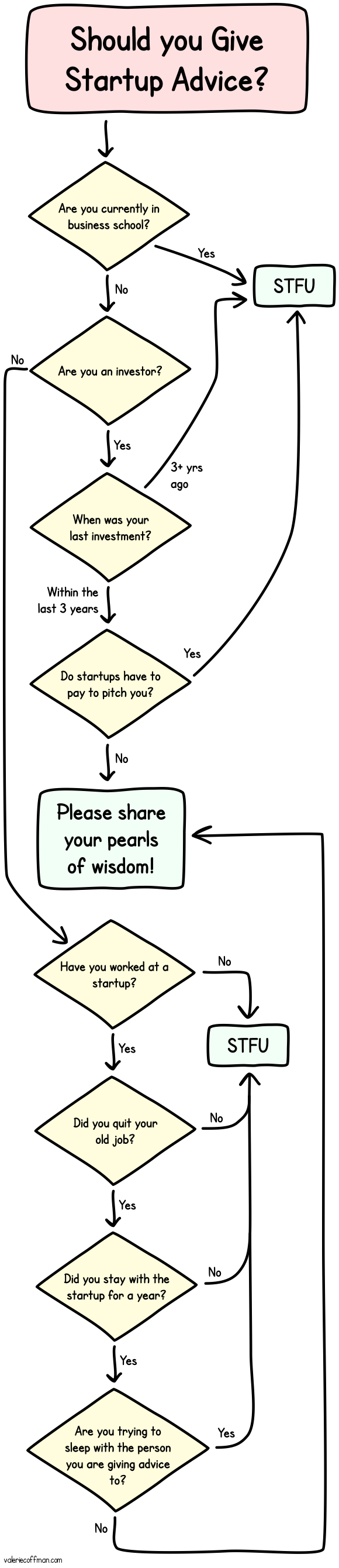
Who should you listen to? Valerie Coffman, a data scientist and entrepreneur, has come up with this flow chart from her website valeriecoffman.com 

Startup Advice, Startup Tips, nibletz


Refinery29, Vox, and the Content Trend That Won’t Stop

refinery29

Last week, I wrote a little primer on content companies–what kinds are out there and how they’re making money.

This week two media companies are announcing some big fundraising rounds. Vox Media, based in Washington DC, announced closing on $34 million of a $40 million round. New York’s Refinery29 will close a $20 million Series C.

Vox Media is the publisher behind SB Nation and The Verge, as well as the newer Polygon. Their overall strategy centers around finding a vertical in which well-educated, fairly wealthy people are interested (sports, tech and gaming, so far) and developing the tech that will bring a great reading (and ad) experience. They sport the typical banner ads and are working on branded video series to keep the revenue coming in. Currently, the Vox Media properties see 60 million unique visitors a month, a number that makes expensive branded content a little more viable.

The Refinery29 story is particularly interesting because, as PandoDaily’s Erin Griffith reports, their funding will specifically help them pivot to a content-only company, as opposed to the content and commerce model they were experimenting with. In turns out that, at least for Refinery29, selling things directly wasn’t working out as well as expected. Only 5% of 2012 revenue came from commerce, while 95% was generated through ads and “branded experiences.”

Both companies rely on the typical advertising avenues, but they are also experimenting with branded content. This could work exceptionally well for  these sites, which have a strong brand personality of their own.

Right or wrong, in tech we often look to investments as the first milestone to success. If investment dollars say anything, it’s a big moment for media companies, many of which are being built everywhere else. We’ve come a long way from relying only on individual blogs and AOL news, and these companies are trying to build brands that will stand the test of time. Can they do it? Investors seem to think so.


Uber Jumps In To Help DC’s Furloughed Federal Workers

Uber, DC startup, furlough, shutdown, startups

We’re now in the 16th day of the federal government shutdown. Startups are trying to help furloughed employees in whatever ways they can.

Last week we reported that Washington DC-based 1776 had launched a website to help match employees with job opportunities and volunteer work for startups. Sure everyone needs money, but some furloughed employees have expressed the fact that they are also bored to tears. The site gives them an opportunity to work with something innovative and exciting. It gives the startup access to a potentially high qualified employee base.

Now the San Francisco based car hailing startup Uber has responded to the needs of the furloughed federal workers in the DC area.

Through Friday, Uber is offering their UberX product free for two rides up to $20 each.

While the Uber app is known for it’s black sedan and SUV service, UberX is a taxicab alternative. Rather than sedan service, users of UberX are picked up in midrange vehicles like Toyota Prius, Toyota Camry and similar type vehicles.  All of the vehicles seat up to four people.

Uber is introducing the UberX product to the DC market, where their original service is still going very strong. At the same time it allows them to expose the service to the capital’s federal work force of hundreds of thousands which have gone without pay for over two weeks. It is important to note that the promotion is actually open to anyone in the DC area, but those affected by the shutdown will find that the company’s promotion came at the right time.

How does it work?

  • Enter promo code DCLOVESuberX in the Uber app.
  • Slide the car type selector to ‘uberX’—this promotion does not apply to uberTAXI, UberBLACK, or UberSUV.
  • Take up to two free rides before Friday, 10/18, at 11:59PM.
  • DCLOVESuberX covers DC area rides up to $20. Trust us—at these rates, $20 will get you far!

Here is a list of participating businesses:

201 Bar
9:30 Club
Al Dente
Argonaut
Atlas Fitness
Atlas Underground
Art Jamz
Bacchus Wine Cellar
Bearnaise
Bethesda Blues & Jazz Club
Blowout Bar
Boundary Stone
Brasserie Beck
Cactus Cantina
Cafe Deluxe
Capella Washington Restaurant
Capitol Hill Fitness
Capitol Lounge
Cashion’s Eat Place
Charlie Palmer Steak
Chef Geoff’s
Chez Billy
Chupacabra
Co Co. Sala
Daisy Baby Boutique
Darlington House
DC Improv
Duo Boutique
Edgar Bar & Kitchen
Farmer Fishers Bakers
Fia’s Fabulous Finds
The Front Page
Graffiato
Granville Moore’s
Gymboree – Play & Music
H Street Country Club
Hela Spa
HR-57
I.M.P. International Spy Museum
Hank’s Oyster Bar
Lauriol Plaza
Liberty Tree
Lisner Auditorium
Mangolens Photography
Marcel’s by Robert Wiedmaier
Mixx
Mellow Mushroom
Merriweather Post Pavillion
Mussel Bar and Grille
Muncheez Mania
Nellie’s
Pure Barre
Queen Vic
Qi Spa
Redwood Bethesda
Scratch DC
Sculpt DC
Shakespeare Theatre
Skin Beauty Lounge
Smith & Wollensky
Soupergirl
Snallygaster
Sticky Rice
Spirit Cruises
The Sweet Lobby
Tango DC
Tom Yum District
Tortilla Coast
Tusuva Body & Skin Care
U St Music Hall
Union Pub
Velocity 5 – Arlington
Vendetta
Vinoteca
Whitlow’s on Wilson
Willow Fashion
Wildwood Kitchen 
Wingos
Zest American Bistro
zipcar


Reaching Your Zen: Relaxing Before an Investor Meeting

Startup Tips, Investor Tips, Guest Post, Tony MonteleoneAn investor meeting often means your livelihood. You’re about to ask a bunch of people to trust in your idea and help you fund it. You’re rightfully excited, and even a little nervous. The only issue is that when you’re nervous, you aren’t performing well, and the investors standing in front of you can see it. To really knock it out of the park in an investor meeting, you’ve got to calm down and slow down. There are a few ways to help you reach some inner peace before you dive into the shark tank.

Slow Down

There’s a theory that says wise people speak slowly. That doesn’t mean they speak in long, drawn out syllables. It means they’re thinking about everything they say before they say it. It’s not even noticeable to the people they’re speaking to.

But slowing down isn’t usually in any person’s head before an investor meeting. From the minute you hear the investor meeting is scheduled to when you jump in the car, your mind is going 150 miles per hour. You’re going over things again and again in your head, trying to make sure that you’ve got your pitch as nailed down as you can.

Here’s the thing, though: once you get into the car, there’s nothing more you can do. You’ve already prepared as much as you can. Think of it like a bride on her wedding day. It’s easy for her to get worked up on the day of the wedding, worried that something might go wrong. But on the wedding day, after she’s zipped up into her dress, there’s nothing more she can do. That’s her chance to just relax and enjoy the day. The same concept applies to you and your pitch. Once you’re on the way to the meeting, it’s time to just slow down, relax, and realize you just can’t cram another memory into your brain.

Avoiding Amygdala Hijack

On your brain stem, the second gland before the brain is called the amygdala. This little gland controls what we call the “freeze, fight, or flight” response. The amygdala produces adrenaline, and it can hijack your brain. When you’re faced with a situation that jumpstarts your amygdala, it fires in .8 milliseconds and it takes over your brain. Your brain—even brains with the highest of IQs—is unable to reason. The only thing you’re thinking about is fighting or getting out of the situation.

After your brain is hijacked, it can take up to 18 minutes for your brain to regain control again. If it happens five minutes before your investor meeting starts, you can kiss your investors goodbye. Countering an amygdala hijack isn’t easy, but it’s possible to avoid it by just staying away from drama. Don’t talk to your angry significant other, and don’t call your estranged brother who’s asking for money. Just keep your mind clear and focused on the task.

Counteracting the Amygdala Hijack and the Positive Hijack

If you do let your brain get hijacked by the amygdala, there are ways you can counteract it. If a tiger was attacking you, your amygdala would take over, and you would either fight the tiger or run away from it. If your brain gets hijacked, do something you wouldn’t do if a tiger was about to attack you. Drink water, sit down, or lean against a wall. This slows you down and calms you down, and helps to counteract the 18 minutes of hijack you’re about to face. In fact, a mark of high-level leaders is the ability to sense a hijack coming on and do something to counteract it ahead of time, like going for a walk.

Your other option is the positive hijack. In a similar way to the amygdala hijack, you can trick your brain into being completely calm. Smells often do that, or things that remind you of something happy. My positive hijack, for example, is listening to Queen’s “Bohemian Rhapsody.” It reminds me of my brother and my childhood, and puts me in a happy place before an investor meeting.

Do what you have to do to calm down before a meeting. In the long term, practice slowing your thinking. In the short term, avoid drama and focus on good things. Take your mind away from the stress. If that’s eating a giant ice cream cone, do it. Find your positive hijacks and use them to dominate your investor meetings.

Tony Monteleone(@StartupTony) is a serial entrepreneur and does Business Development for PERQ, a marketing technology and promotions company that specializes in increasing online and in store traffic for businesses. He also serves as the Indianapolis Chapter Director for Startup Grind.


Fortune Names the 2013 Most Powerful Women Entrepreneurs

business-women-wardrobesYEC

At Nibletz, we love to hear and tell stories of awesome women entrepreneurs. People often think that women are getting the short end of the startup stick, but when you look around, it’s easy to see female-led companies excelling in almost every space.

Fortune agrees that it’s important to celebrate women entrepreneurship. Since 2009 they have come out with a list of the 10 Most Powerful Women Entrepreneurs of the year. Women like Susan Koger of ModCloth, Sheila Lirio Marcelo of Care.com, and Rashmi Sinha of Slideshare have all been on past lists. In order to be considered, companies must have revenue in the $1 million to $25 million range. They aren’t necessarily household names (yet!), but the Fortune panel believes they have created innovative solutions that will become global.

This year’s list includes a woman making the construction industry more “green” and the founder of ticketing company Eventbrite. Many of the women have built companies around problems they themselves encountered in every day life. Frankly, if Sari Davidson had invented the SippiGrip when my kids were babies, my life would have been totally different!

What I find interesting about this list, though, is the age of the women included. We usually think of startups as a youth-only space. Hoodies and all-night hackathons are for 20-somethings. However, the youngest woman in the group is 31, and the average age is 43. For the most part, they aren’t building tech giants, but they are solving real problems in innovative ways.

The ten women on this year’s list will be honored at the 2013 Most Powerful Women Summit that starts today in Washington, DC. Here are the women included:

Find out more at the Fortune Conferences website.


How LaunchHouse Redefines Social Networking

Todd Goldstein (l) and Dar Caldwell (r), co-founders of LaunchHouse

Todd Goldstein (l) and Dar Caldwell (r), co-founders of LaunchHouse


Like many of today’s adults who are past the traditional college roommate stage of their lives, Mitch Turck shares a house with others who are saving money by living together. But unlike those who have cobbled new housing arrangements out of financial stresses, Turck was one of 19 applicants for nine available spaces in two homes. Previously based in Pittsburgh, the entrepreneur researched accelerator programs, applied for this unique startup “neighborhood,” then picked up and moved in August….to Cleveland.

The city commonly known as the “Mistake by the Lake,” Cleveland might be the punchline of many jokes. For entrepreneurs looking for a cost-efficient and supportive base from which to grow a startup, however, this Midwestern location offers some seriously kick-ass perks. A lot of those benefits are thanks to LaunchHouse (http://launchhouse.com), a startup accelerator that came on the scene in 2008. Home to more than 200 companies through its co-working office program, LaunchHouse added two actual houses to its leasing options in April. Located just around the corner from its 23,000 square-foot main facility, the two residences are filled with entrepreneurs like Turck. They come from a variety of locales, two from as far away as China.

“Why would anyone ever move to Cleveland?”

The question is posed, and promptly answered, by Todd Goldstein, Chief Executive Officer of LaunchHouse. Along with co-founder Dar Caldwell, Goldstein has been at the front lines of creating this tight-knit startup community.

“This is bringing interest from all over the world,” says Goldstein. “Only 30 percent of the applicants for the housing were from the northeast Ohio region. We’re here in Cleveland asking what early-stage entrepreneurs need. They need social, cultural, and educational support. They need an ecosystem.”

And what an ecosystem it is. Entrepreneurs who reside in the two houses and those who use the co-working spaces at LaunchHouse enjoy more than just hot coffee. There’s the expected: whiteboards, first-come-first-serve desks, private offices, copiers, conference rooms. And there’s the decidedly unexpected: a gigantic open production space housing enterprises ranging from landscapers and agricultural suppliers to videographers and fashion designers; hens housed in the parking lot; a puppy following Caldwell as he gives a tour; 3-D printers; Gigabit broadband with super-fast Internet access.

In-house eggs + Gigabit connectivity = LaunchHouse ecosystem

What?  The same space that has in-house fresh eggs also boasts connectivity rivaling that of Google Fiber’s Kansas City Startup Village. LaunchHouse partnered earlier this year with OneCommunity (http://onecommunity.org), a nonprofit established in 2003 that owns and operates a high-speed all-fiber network spanning 24 counties and over 2,000 miles in northeast Ohio. Experienced at providing data service for more than 2,300 public institutions, OneCommunity first worked with LaunchHouse to bring the high-speed Internet to the 23,000 square feet of co-working space. The two enterprises turned the corner, literally and figuratively, when they partnered to extend the service to the two LaunchHouse entrepreneurs’ residences which are located on a quiet side street just off the busy commercial setting of the accelerator’s Lee Road location. Think of it as northeast Ohio’s first “fiberhood.”

While the high-speed connectivity is certainly a draw for those who want to live in an entrepreneur house or pay as little as $125 per month for 24/7 access to the co-working space, it’s the social connectivity fostered by LaunchHouse’s leadership that really makes it work as a startup accelerator. For instance, Caldwell, Goldstein and the five partners they’ve added to the LaunchHouse team since 2008 host 20-25 MeetUp groups per month. There is always something going on at LaunchHouse.

“They’re all encouraged to use the space for free,” says Caldwell. “We have hackerthons here, workshops, our ‘Whiteboard Wednesdays’ when we brainstorm ideas. It’s an open community.”

Social, social, social: the startup’s version of real estate’s “location, location, location”

For Jeremy Handel, managing partner of Handelabra Studio and Handelabra Games (http://handelabra.com), the openness at LaunchHouse benefits his creativity – and his business. The videogame developer took the much-worn path tread by many entrepreneurs: from attic office to coffeehouse office to traditional office. That last one, with its traditional rents, proved too expensive; Handel moved to LaunchHouse about one year ago and became one of their portfolio companies. (LaunchHouse invests in selected startups).

“Initially, I moved here because it’s cheaper,” says Handel. “But the number one selling point is the social. I get up and walk around, talk with people to see what’s going on. It’s the first place that has felt collaborative. Here, an idea shared is grown, not stolen.”

And Turck, who is growing his Vendalize (http://vendalize.com) local search tag startup both in the entrepreneur house and in the co-working space, agrees. “In an office by yourself, you have to motivate yourself. When you’re socializing with others, the pace is faster. It’s easier to work harder.”

Juli Kaylor Gray has covered traditional business topics, as well as offbeat fare ranging from lenticular art exhibits to the “wedding-on-a-hike minister,” in her ten years as a freelance writer and magazine editor. Based in Cleveland, Ohio, she’s a focused Tweep at @QuirkyCleveland and a distracted blogger at http://quirkycleveland.com/.

12 Ideas for Spicing Up Your Startup’s Blog

QUESTION: WHAT ARE SOME TIPS FOR CREATING REALLY INTERESTING COMPANY BLOGS EVEN IN MY DRY, BORING OLD INDUSTRY?

TAKE READERS BEHIND-THE-SCENES

Even in a “dry, boring old industry,” your blog readers will be fascinated to see the hidden, behind-the-scenes vantage point of the company. Incorporate photos or video to enhance plain text blog posts, and use a variety of writers to bring in diverse perspectives from the team. And of course, post regularly to keep your audience engaged.”

– Doreen Bloch | CEO / Founder, Poshly Inc.

GO POP CULTURE

“Using pop culture references can be a great refresher. For example, my company blog focuses on the subject of presentation and video. When Coachella featured a Tupac hologram earlier this year, the web went abuzz with questions asking if this was a new feature of presentations. Of course, we jumped on the discussion, explained some costs, and our opinions on the matter.”

– Kenny Nguyen | Founder/CEO, Big Fish Presentations

WIN WITH VIDEO

“We liven up our blog by periodically creating a video-based post. Just use the webcam on your computer to speak openly about a specific subject that’s relevant to your audience. Our readers feel more connected to us when we create video posts, and the responses have been overwhelmingly positive.”

STOCK UP ON CASE STUDIES

“I learned the importance of stories through the book, Made to Stick, by Chip and Dan Heath. Even when a topic is boring, people love to hear about the emotional struggles that people faced when implementing something new. For example, if you are in the concrete industry, talk about the joy your customer had when they got their driveway paved. Think about both the product and the people behind it.”

– Lawrence Watkins | Founder & CEO, Great Black Speakers

SHOWCASE YOUR CLIENTS

“Interview your best clients for their stories about how your company gave them value, and inject some personality into the blog. Ask these clients to explain how their perception changed from boring and stuffy after working together. Even if the process is boring, get them excited about the results and share those with perspective clients on the blog.”

BECOME THE INDUSTRY EXPERT

“My target market for RewardMe was restaurant and franchise owners. We were in a dry and boring industry — the customer loyalty space. Instead of exclusively blogging about customer loyalty, I decided to become an expert in local marketing. We wrote about local social marketing, restaurant hardware, and customer loyalty. We were so good that we now rank very high on search engines.”

– Jun Loayza | President, Ecommerce Rules

SHAKE UP YOUR INDUSTRY!

“If you think your industry is dry and boring, you need to shake things up by coming up with ways to make it worth paying attention to. Why does it matter to you? Get personal, share success stories of people in your industry or your clients, and don’t be afraid to turn what you’re “supposed” to sound like upside down.”

CREATE INTERNAL EXCITEMENT

“Get employees to blog about something that excites them. We created the “Prolific Innovation Fund” which allows everyone to purchase a mobile accessory and write a review on it. It is creating team excitement, innovation and a lot of great relevant content for our company blog.”

PROVIDE UNIQUE VALUE

“No matter what your company does, there’s information, inspiration, and/or entertainment customers are looking for in the space. Provide something consistently valuable — and something people passionate about this space couldn’t get elsewhere — and you’ll engage your current users while finding new ones.”

– Derek Flanzraich | CEO and Founder, Greatist

ENTERTAIN WITH INFOGRAPHICS

“For the average American, the crowdfunding industry and the JOBS Act may seem like an alien concepts filled with complicated, dry details. We’re currently working on an infographic to feature on our blog that will detail the impact of the JOBS Act and the widespread change the implementation of the act will bring. The visual representation of the change makes it approachable and engaging.”

– Eric Corl | President + Co-Founder, Fundable LLC

MAKE IT TRENDY

“Tie your business into the hottest trends. For example, anyone in any industry can blog about, ‘What Fall TV Previews Teach Us About [your industry]’ since you can take elements of fall TV previews — promotion strategy, engagement, specific show themes — and spin it for your own business. It’s all relative!”

– Melissa Cassera | President and CEO, Cassera Communications

MAKE OTHERS BETTER

“A counter-intuitive approach is to invite the other “dry, boring” players to participate in your fun. Get them excited at what you’re doing in the industry, and encourage them to participate in your blog. Feature your competitors! Be the source. Great players make the players around them better. (At my first company, I had the job of blogging in the vending machine industry. Yes, it can be done.)”

– Luke Burgis | Director, ActivPrayer

The Young Entrepreneur Council (YEC) is an invite-only organization comprised of the world’s most promising young entrepreneurs. In partnership with Citi, the YEC recently launched #StartupLab, a free virtual mentorship program that helps millions of entrepreneurs start and grow businesses via live video chats, an expert content library and email lessons. 

Tackk Wants to Prove Tech Can Be Done Anywhere

tackk

Crain’s Cleveland Business Journal is reporting that Cleveland-based Tackk recently received $1.2 million dollars in a funding round led by ff Venture Capital out of New York. The 1-year-old startup helps users create simple web pages, a la Tumblr. In fact, Tumblr-size success is the exact mark they’re shooting for.

“We invest in companies where we think they can change the behavior of millions of people. I can see absolutely no reason why you can’t have millions of people using this,” John Frankel of ff Venture Capital told the Cleveland Business Journal.

“Ridiculously simple creation + sharing,” it says on the Tackk homepage. And, it is just that simple. The homepage allows you to drag and drop pictures, edit text, and play with colors, fonts, and backgrounds without even creating an account. (Registration is required if you want your Tackk up longer than a week.) The Tackkboard allows you browse Tackks on a variety of topics, and you can like and share your favorites.

Despite the comparisons to Tumblr, Tackk isn’t necessarily seeking to become a huge social network. CEO Christopher Celeste told TechCrunch’s Anthony Ha that they were more interested in helping people create and tag content, then push it out through whatever social media or physical way they desire.

The recent seed round will be used build out a mobile platform and make it easier to browse Tackks.

According to the Business Journal, investors suggested the team move to New York to complete the next stage of development. The team said no way, and they are now building what they hope is the next great content creation tool right at home in Cleveland.

As the voice of startups everywhere else, we at Nibletz think that’s a great decision, but it’s not one that every company makes. I asked Eric Bockmuller why he would want to stay in Cleveland, when all the money is telling him to move.

Our founding team was born and raised in Cleveland, we have a connection with the city that I think only fellow Clevelanders understand. We see an opportunity to create something special that typically doesn’t happen here. We know it may be more of a challenge, but we understand that we’re not just building a great Cleveland company. We’re building a great company that lives in Cleveland but impacts the whole world.

The second part of his answer was surprising: talent.

Many startups tell us it is hard to recruit good talent outside of Silicon Valley, but Bockmuller doesn’t see it that way. With tons of talented students graduating from the universities in and around Cleveland, the Tackk team is seeing many who are willing to stay at home and build the next great tech company.

Bockmuller also acknowledges that there will be challenges. Without success stories going before them, they have fewer mentors and examples than you find in the Valley. It’s also more time consuming to meet with investors when that meeting involves a flight. But Bockmuller is an entrepreneurs and has a cheerful answer for these challenges:

There will always be the questions around talent, money and scalability being based in Cleveland and we believe the opportunity to overcome those questions is now with Tackk…it only takes one to change a region.

Go check out Tackk and keep up with them on Twitter.

An Online Fashionista Learns Business At #EECincinnati

protectyourpumps

A few weeks back I literally stumbled across a web post about an upcoming conference called Everywhere Else. The event was to be held in Cincinnati and was geared towards start ups located in the Midwest, with a focus on connecting entrepreneurs with investors. I wasn’t necessarily looking for an investor for our company. However, I decided to register and attend. Cincinnati is only a 6 hour drive from Milwaukee and figured I might learn something and meet some cool people. I’m glad I took the road trip, because I was able to do both!

In 2011, I started a company called www.protectyourpumps.com. I consider myself to be a legitimate “shoe addict” with a shoe collection that is about 80% high heels. I believe women feel the most beautiful, confident and alive when wearing shoes they love. Like most ladies, I didn’t mind spending a good chunk of change on quality shoes, however it was frustrating when they became damaged quickly. For that reason, I started a business to sell protective items for ladies footwear, allowing them to step out in confidence.

It’s no secret the major fashion hubs in America are in Los Angeles and New York, so I often travel to attend various fashion events. Attending Everywhere Else Cincinnati was a bit out of the box for me as it was not at all fashion related. In attending this conference I learned  business is a lot like music. Listening to only one genre of music can be quite boring and in doing so, you miss out on a lot of good tunes. The same applies to business. As entrepreneurs we are all on similar journeys. It’s great to mix it up sometimes and learn from someone in another industry.

The presentations at Everywhere Else Cincinnati were jammed packed with useful information. Here are my top 5 takeaways, which I plan to use help grow Protect Your Pumps.

1.) Dear Countermined, Please go away! Prior to this conference I honestly had not heard of Andrew Warner or Mixergy. (I know shame on me) However, I left feeling very inspired by him and the journey he is on. He gave a great presentation on your true mind (true,useful and wanted thoughts) vs countermined (not true, not useful and not wanted thoughts). I’m excited to implement some of the practices he talked about to shut my countermined down because hanging on to the negativity only holds me back.

2.) 299 is not 300 Jeff Hoffman founder of Priceline knocked his presentation out the park! He delivered an invaluable tip for entrepreneurs, run hard to the finish line! Jeff said doing 299 of something when you are suppose to 300 is essentially giving up and that is the difference between you and the other guy (or gal).

3.) Your Brand is Your Personality Show it off! In my notebook the only word on the page about Patrick J Woods was AWESOME! He talked about giving your brand beliefs and personality. I hadn’t really thought about it in that way and I’m excited to say we currently have some things underway to really develop the Protect Your Pumps brand more and bring it to life!

4.) Start up CEO=Sales(wo)man and Sales Manager Evan Owens said “All Start up CEO’s are salesmen and sales manager. Learn that role and you’ll soon be leading an organization worth talking about.” That struck a chord with me because in the world of so many internet distractions, it is easy to get away from what is going to keep your business thriving which is SALES.

5.) Respect Niche Skills Evan also said “If you meet a guy who claims to be the best at web development, design, seo and social media. He probably isn’t that good at anything.” This is very important because as a start up, lets keep it real money can be tight. We always want to get bang for our buck. However, finding good people who are strong in a particular area is crucial.

My list of takeaways from this conference goes way beyond 5, however I just wanted to share a few. I’m excited to take these lessons and put them in action. I’ll see you in Memphis!

Kathryn Jackson

CEO/Founder Protect Your Pumps

Author of Blog Skipping in Stilettos-Shoes+Substance

www.skippinginstiettos.cm

www.protectyourpumps.com

Facebook: Protect Your Pumps

Twitter: @KathrynNJackson @Protect_Pumps

Instagram: Protectyourpumps

What Does It Cost to Run a Startup? [Infographic]

There are many costs associated with running a startup. Designers, developers, office space and supplies, and travel all add up. While each company will have costs unique to them, it’s pretty safe to say that starting a world-changing company is expensive.

We’ve always said location makes a difference, though. It’s expensive to live and work in big hubs like San Francisco and New York. Investor money can go further in the flyover states than it can on the coasts.

Staff.com–a startup that connects companies with talented remote workers–produced an infographic outlining the costs of starting up in different cities worldwide. They calculated to the cost of office space and the salaries of 2 developers and 1 designer to find which city was most expensive to start up in.

Surprisingly, New York came in third, behind Zurich and Sydney. San Francisco was only marginally cheaper than New York, and Manila came it at the least expensive. In the Philippines, you can apparently start up for $45,000 a year, which is half the salary of 1 developer in Zurich.

Of course, not every startup needs office space, or 2 developers and designer. Coworking can make office space less expensive, and these days a lot of things can be outsourced. Regardless, it’s interesting to see the numbers support the idea that starting up everywhere else has financial benefits, too.

Check out the infographic from Staff.com below:


What Does It Cost to Run a Startup? Infographic
Staff.com – Connecting Great Companies with Global Talent