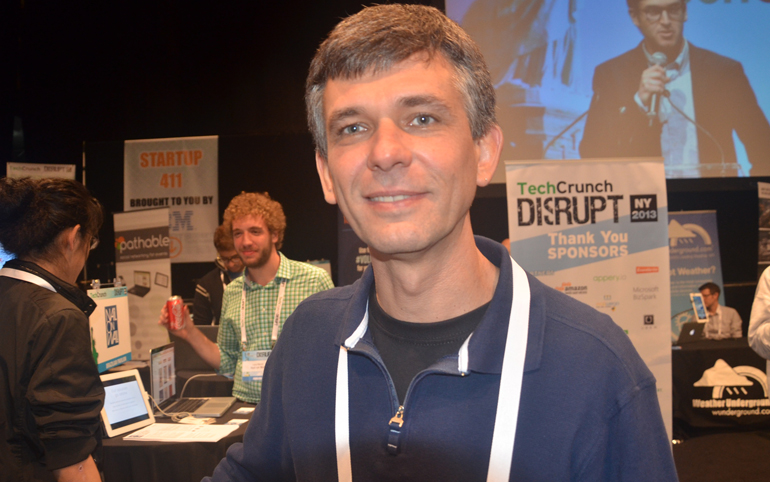
The old lady in “The Clapper” commercials would be very proud of Israeli startup, ClapTo. We found them in the Israeli pavilion at TechCrunch Disrupt NY 2013.
Shay Dadush, the founder of ClapTo, created the starutp after experiencing a real world problem that many workers face. Whether you work in a customer service center, data entry office, or coworking space, if you work with headphones on, communicating within the workplace can be a challenge.
“Sometimes you think someone wants you and they don’t, other times the boss wants you and you don’t hear them” Dadush told us at Disrupt. That’s why he created ClapTo.
ClapTo is a piece of software that fits ontop of your audio settings and listens for two claps in a row. If ClapTo hears the right claps then it quickly pauses whatever audio source you’re listening to so that you can hear what’s going on around you. Now all Mr. Lumbergh would have to do is clap two times to cut your music off so he could ask you to work this Saturday.
Dadush tells us that ClapTo knows the difference between the clapping, and someone making a loud bang.
This seems kind of cool but if ClapTo builds massive scale what’s going to happen when 30 people in the office have it installed and someone claps. Tell us what you think of ClapTo in the comments below.
Here’s the video, you can find out more at clapto.com
The nest thermostat was the coolest piece of hvac innovation ever. It’s got a beautiful design and the functionality is amazing. Now if you’re not familiar, Nest, learns the behaviors of those in the house and programs itself to optimize your comfort and energy in regards to your heating and cooling.
What New York entrepreneurs Ryan Fant and Nayeem Hussain have discovered, is that the thermostat is only about half the problem. Energy loss and discomfort also stems from the vents itself. Nest, controls the heat pump or the ac unit. The vents are controlled manually.
“We found that just by closing four vents in an average-sized home, we’ve reduced the run time of the furnace by about 30 percent,” Fant explained in an interview. “So not only were we redirecting air to rooms that were actually in use by intelligently closing vents, we were increasing efficiency, as well.”
Their vents can be controlled by smartphones, learn a users behavior and open and shut automatically based on imported data. Overall this will improve the energy efficiency in homes and make them more comfortable.
The duo are predicting a 32% reduction in run time on hvac units thus resulting in money and energy saved. Vents haven’t changed in 60 years they’re basically the same design. When making their pitch it’s obvious that they are looking to the immediate future as smart homes become more mainstream and less sci fi.
In an interview with Nibletz Hussain tells us that the Keen Vent is just the beginning. Their next products are equally as simple, and equally as life changing. Check out our interview below and for more info visit mykeenhome.com
Ping Pong is a right of passage for some early stage startups.
As startups grow up and move out of the spare bedroom or the garage they look to make their first office space more “startupy”. Often times you have to do it with a budget. So what does a bootstrapped startup do to give their new office the “startup feel” without breaking the bank on some full sized upright arcade machines, or the latest virtual reality gear?
Well the “pop some tags” of course, and go for the ping pong table.
Over the last 18 months, travelling on our “sneaker strapped road trip” I’ve become actually decent at Ping Pong. I think we’ve seen over a 100 ping pong tables at various startup spaces. It’s funny how HD Tvs and Nintendo Wii’s can sit dormant forever, but find a few developers and designers and when they take a quick work break it’s for a fast game of ping pong. (we’ve been informed that the table tennis snobs don’t like it when rec players call it “ping pong”)
Well we got a tweet as TechCrunch Disrupt NY 2013 was starting. The tweet, from PaddleYou, told us to come by their booth at Hardware Alley on Wednesday, they had something for us.
So of course, the first thing we did when we arrived at the Manhattan Center was go find that PaddleYou booth. PaddleYou’s Cooper Fallek showed us the awesome Nibletz ping pong panel and explained the features. This paddle will make us beast on the table tennis courts of startups everywhere else.
Check out the video interview below. For more info or to order your own custom ping pong paddle, visit paddleyou.com
Lost and found is pretty boring and in a lot of respects, un-effective says Pinaki Saha CTO and co-founder of Chicago startup Crowdfynd. Currently, the traditional vehicles for lost and found are not nearly as effective as they could be using the broad scope and reach of the internet.
Unfortunately too many of us know the ritual of printing out signs for a lost dog or cat and stapling them to every tree and lamp post in the neighborhood. We also know too well that losing something of value can prove fruitless unless you happen to stumble upon some very honest people. In other cases, items that some people have lost are extremely valuable to them, and could be perceived as junk to others.
Sure there is a lost and found section on Craigslist but even the most regular of Craigslist users don’t check that section everyday. So why not create an app for that.
That’s what Crowdfynd is all about. It’s a social platform and community using the crowd to help locate the things you lose or find. It can also be used for crime reporting.
How it works.
Using your iPhone or Android device you can report things you’ve lost or found. You can upload pictures of the lost item if you have them, or pictures of where you think you may have lost an item. You can also upload pictures of things you find. Crowdfynd connects the finders and the losers to make a match and get things back to where they belong.
Saha says that Crowdfynd offers social, local, mobile and 3.0 components to make it stick. They also have a reward platform as well. People who lose items can offer a reward and collect it through the system insuring the safe return of the item. Saha has found people are offering rewards in the hundreds of dollars. He says that cat owners are offering rewards in the thousands of dollars.
They also have an offline hybrid where someone who loses something can print out signs to hang up in the neighborhood that directs them back to their Crowdfynd page.
People are chiming in because there’s a “Goodwill” factor about helping people. Crowdfynd is also hoping to partner with businesses too like cab companies, airports, hotels and restaurants where people are known to lose things. They hope by building up their network that they can be the one destination for people who lose and find things.
In order to do this though, Crowdfynd is going to need to build tremendous scale, very quickly. Saha says they’re prepared for that and have a lot of money they are going to invest in marketing and getting the name out there. They plan on unveiling the service in Los Angeles, New York and San Francisco to compliment their first market, and their home market, Chicago.
Check out our video interview with Saha below and for more information visit crowdfynd.com
When our good friend Donna Harris left Startup America earlier this year we were really excited about what her and Washington DC Startup America Champion Evan Burfield were going to build. Now 1776 is a reality and the nation’s capital, and the nation for that matter are talking about it.
Back in March we brought you an interview with “Her Story” our first 1776 interview.
For those not in the know 1776 is Washington DC’s new startup and entrepreneurial epicenter. Think event space, co-working space, and incubator. 1776 is the heart of DC startups, in fact DC Mayor Vince Gray sported a 1776 T-Shirt while perusing SXSWi.
While 1776 is on this leg of the sneaker strapped startup road trip we were ecstatic to meet quite a few DC entrepreneurs who roam the halls of DC’s new startup space. Our good friend Brian Park with Startup Grind DC, was volunteering at Disrupt. He holds the Startup Grind DC events at 1776.
We also met Kevin Ostrowski and Gary Mendel, who’s startup YoPine is a resident at 1776. Kevin is still based in New York but Gary works out of 1776 which is where YoPine is officially headquartered.
YoPine is the first (of many) mobile apps that do polling correctly.
How does it work?
Say you want to find the best place to watch the Washington Redskins play on any given Sunday. Typically if you sent out a group text you would get 100-300 messages back with most people taking 3 or 4 texts just to answer the question. Then you would have to circle back with all of those texts and keeping that organized can be a complete mess.
With YoPine you simply ask your contacts through the YoPine app. If your contacts have YoPine they will answer via app and if they don’t they can answer via text message and mobile website.
You set up the question, input some possible answers, select the contacts you want to poll and hit send. Voila, you’ll get the results you’re looking for quickly. You can then send the results back out to everyone that participated.
YoPine’s UI and functionality are much better than any of the “hot or not” clones we’ve seen to date. There is huge potential in the platform. We’re sure there’s a reason that a social polling platform is headquartered in the political capital of the world (wink,wink). Check out our interview with Kevin from TechCrunch Disrupt NY 2013 below. You can find out more at YoPine.com
Public data is a huge gigantic mess. Some municipalities offer everything in indexed searchable sites, while others send you cd roms of property values and tax records. Still, some municipalities require that you go down to their town hall or courthouse and sift through filing cabinets as if they’re trapped in the 1970s.
Cumulatively you’re talking about 100’s of millions if not millions of records of data, and none if it’s uniform. It’s possibly the largest big data project in the world. An ambitious project, taken on by Hicham Oudghiri and Marc DaCosta co-founder sof Enigma.io, as well as CEO Jeremy Bronfmann.
There are mountains upon mountains of public data. What is “public data” it’s really determined by the municipalities themselves. For instance, tax records, property records, marriage licenses, etc are just about public data in every town and city across the country and around the world. In some municipalities though, restaurant food scores, public transportation records and even dog licenses are considered public data.
Sure there are scammy data sites that off-shoot to wanna be background reports, but Enigma is out to do something bigger. They want to create an entire new layer of the internet in the next five years.
Enigma has already raised $1.1 million dollars in seed funding from Triple Point Ventures, CrossLink Capital, and angels like YouTuber Brent Hurley. They’ve also inked some important partnerships with Harvard Business School, Gerson Lehrman Group (a research firm), S&P Capital IQ and The New York Times.
One of the challenges Enigma faces is the rapid rate at which more and more data is released to the public. Yet another thing that Bronfmann says their team is ready for.
Enigma started to amass this huge collection of data by sending a ton of Freedom of Information Act requests. They’ve had to compile the data in one simple, easy to use format even though it comes in a variety of sources. Bronfmann told us in an interview that some data even comes on “print outs”.
The scope of what Enigma is looking to achieve along with the powerhouse team and the work they’ve done to date, was enough for them to win the TechCrunch Battlefield competition on Wednesday. That honor comes with a $50,000 non-equity prize and of course startups that have won in the past like UberConference and GetAround, have gone on to raise huge rounds.
Check out our interview with Bronfmann below and sign up for more info about Enigma here at enigma.io.
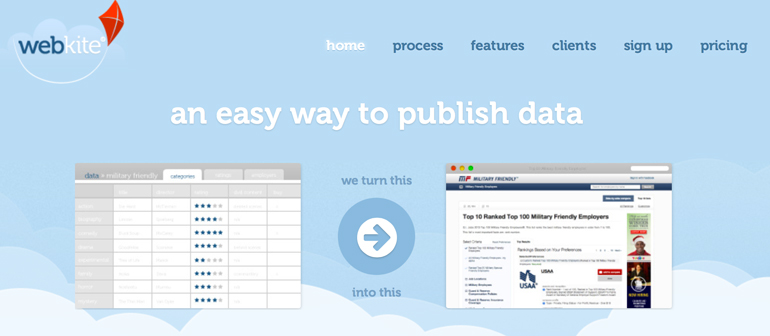
Pittsburgh entrepreneur and angel investor, Eric Silver, was in the Startup Alley at TechCrunch Disrupt NY 2013 on Tuesday showing off his latest startup called WebKite. The idea behind WebKite is to aggregate data in a comparative analysis format enabling anyone who wants to create a site like kayak.com, do just that.
Silver and his team noticed the value in comparative data sites like Kayak but quickly realized there weren’t more of them because the back end coding and data aggregation is a long lengthy process. They’ve simplified that process by allowing anyone to create a comparative data site.
As Silver explains in the video below, the data can come from a variety of sources, API’s, spreadsheets and data scrapes just to name a few.
Once the data is put in it’s output is fully customizable, easily updatable and comparable. For the example at their Disrupt booth they showed off a site that compares juicers. With this particular “kite” when new juicers are added to shopping.com or Amazon.com they are automatically added to the juicer site.
It seems that Silver has found a hole and was willing to put his money where his mouth is. He is the principal with alt-capital which invests in early stage startups. He invested in ModCloth and has also founded a startup called Pikimal that has since pivoted to WebKite.
Pikimal is a decision making platform that makes fact based recommendations over a wide range of categories. The startup was growing fast, until the “Google Panda” changes back in February 2011 just about crippled it.
Silver, a Peace Corps alum, is a natural born problem solver who had the patience and foresight to solve his Pikimal problem. What he decided to do was pivot to offering the technology that Pikimal was built on, as a white label service, and eventually turning it into the WebKite product we saw at Disrupt.
It’s not sexy or a cool new social food restaurant finding comparison app in the cloud, but if Silver executes on this the way it looks, WebKite could be one of the biggest things to come out of TechCrunch Disrupt NY 2013.
Check out our video interview with Silver below, you can check out WebKite here.
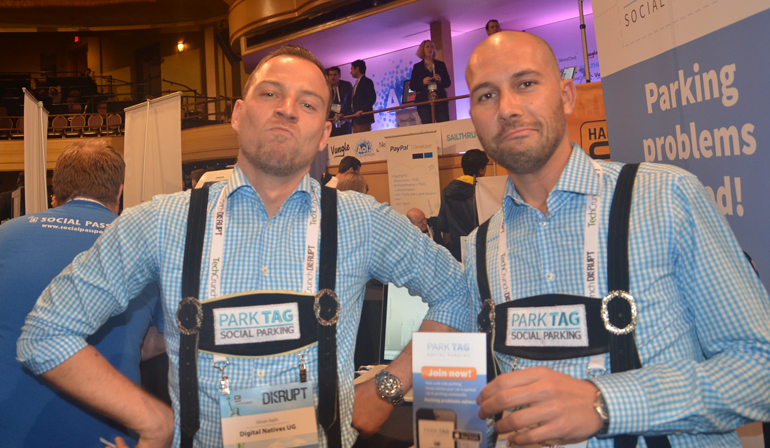
A startup from Berlin Germany called ParkTag came out to TechCrunch Disrupt NY 2013 all decked out to draw attention to their startup. Parktag is a peer 2 peer social parking application.
Here’s how it works:
You’ve parked in a public parking spot and gone into your favorite restaurant for lunch. When you are getting ready to finish lunch you go to ParkTag and let the app know you’re about to leave your parking spot and where it is.
Someone who is in the area and needs the spot will see that your spot is coming available. They go to the spot and wait for you to arrive and move out of the spot.
Once you pull out, they pull in, in what ParkTag calls the “Handoff”.
When the new person parks their car, they send you a thank you and voila they have a parking spot. Users can earn point by making the transactions as smooth as possible.
ParkTag is up and running in Europe where they say people love it. Things could be a lot different in Europe but I’m not sure that drivers in the U.S. have the patience to effectively use ParkTag. There’s a good chance that while you’re waiting for the spot you would block traffic and people would quickly become frustrated with you.
Without building immense scale people in the US aren’t going to understand that you reserved the spot via the app.
ParkTag doesn’t seem to have those problems in other countries. I’m very interested to see how it turns out if they do come to the US.
Check out the video interview and learn more about this great idea below.
Pablo Arellano Jr is serious about starutps and entrepreneurship. How serious? Well he just went through Arkansas’ Ark Challenge accelerator with one idea, pitched a different idea (3DLT) at Startup Weekend Cincinnati last summer, is a startup event organizer and the Startup Digest curator for Cincinnati, Arkansas and Northern Kentucky.
We met Arellano at Startup Weekend Cincinnati last summer. It was there that his idea for a “99 designs for 3D printing” was born. Naturally with 3D printing being such a hot space it was selected to build over Startup Weekend and they came in second.
Arellano kept pushing and while he was in the Ark Challenge program with his other starutp he met the rest of his 3DLT team. They realized quickly they were onto something extremely hot. When Ark Challenge closed out Arellano and his teammates returned to Cincinnati where they are housed at the new Cintrifuse incubator. One of their biggest mentors and advisors is Rob MacDonald, co-founder of Cincinnati’s “The Brandery” as well as the son of the sitting CEO at Proctor & Gamble.
In February the team from 3DLT won a spot onto the Battlefield Stage at an event in New York City. From there it went into hyper mode so that they could pull off a great pitch and get ready to serve the public. For their big kick off Arellano is giving away $10,000,000 worth of memberships on the site right now.
3DLT has evolved from a simple place to buy 3D templates to a marketplace for both templates, and eventually goods that a consumer can produce in their home.
In the feedback section, David Tisch was concerned that Arellano didn’t talk enough about the business, “Why did you just spend 6 minutes talking about 3d printing and not your business.”.
Other than that hiccup the team seemed to have good answers, but overall the truth of the matter is that 3D printing is on fire, just six months ago it was unheard of to have a 3D printer in the home. On the way to New York I saw an at home 3D Printer in the SkyMall magazine for under $1000 and Arellano told me there was a kit to build a 3D printer at home for under $200.
The team at 3DLT sees a time coming, sooner rather than later, when people will be able to create products they need or want in the home. Toys, shoes, sunglasses, cups, plates and other items will be cheaper or easier to produce in home rather than travelling down the road for WalMart.
President Barrack Obama said 3D printing was a gamechanger, and Arellano didn’t let that slide, a video clip of that speech was in his presentation.
If they keep their fingers crossed 3DLT could end up finishing in the top 3. They’re ready for the 3D world and no Zach Sims, there aren’t any other platforms out there like 3DLT, we checked.
Here’s Arellano pitching 3DLT at Startup Weekend last summer:
3DLT made it from a Friday pitch at Startup Weekend, to this, pitching on the TechCrunch Disrupt Battlefield stage.
There are haters everywhere, or at least that’s how the song goes. Lord knows I have a bunch. That’s why Jake Banks created Los Angeles startup Hater. It’s the world’s first social network surrounded by things people hate.
The social network is alive and growing at a very quick rate. People are finding lots of commonalities over the things they hate. It can be anything from hating the New York Yankees to hating pickles on a Big Mac. It can even be hating your ex-girlfriend. But, co-founder and Chief Marketing Officer Andrew Batey says “It’s not about bullying”.
Hater App works on your mobile device. Download it from the app store and you can immediately start identifying the things you hate and identifying with the people who hate similar things. If a person becomes the subject of too much hate, or things get inappropriate (to a degree) they will get filtered out.
To date there’s been nothing available like Hater, and it’s caught the eye of celebrities like Teyana Taylor, Wiz Khalifa and Fat Joe who will feature the app in his next show. “Fat Joe’s people found out about Hater and reached out to us” Batey explained to nibletz.com at TechCrunch Disrupt NY.
Hate isn’t always used as a bad thing though. Batey explains that there are celebrities that are getting together over issues like global warming and getting users to say why they hate global warming. “Users may say things like I hate global warming because I can’t breathe” Batey said. It’s a great awareness tool and it’s blowing up.
Hater launched at SXSW and since then Batey and Banks have been hard at work promoting their startup globally. They recently did New York Tech Day, TNW in Amsterdam and now TechCrunch Disrupt 2013.
“You don’t always have to like something, and the option to hate or dislike has been missing out there. Everyone has something they hate; now you can and it’s better than therapy.” Banks said in a statement.
Mashable recently featured Hater in “8 standout apps from March” which is a particularly big honor considering how many apps were released at SXSW which fell during that month. They’ve also been featured on Wall Street Journal live. People are quickly beginning to see that Hater app is a lot deeper than you may think.
Companies like Netflix, Amazon Prime and Hulu have started making a dent in traditional cable tv consumption. More and more people, globally, are watching tv shows and movies on other screens like, laptops, mobile phones and tablets. This has caused most cable companies (especially in the US) to move to other sources for revenue like telephone lines and cable internet.
Hulu, Amazon, Netflix and other similar companies are offering shows and movies a la carte and on demand. You subscribe to one of these services for a nominal fee and you can access whatever programs you want to watch, when you want to watch them. This model is working very well for many consumers, but the space as a whole is gearing up for another disruption.
There are some startups like, Jacksonville startup whata.tv, that are hoping to reinvent tv by allowing users to subscribe to one channel a la carte and get the entire programming from that channel in real time or on demand. Many analysts have suggested that this kind of model is where tv is heading.
On the other hand, you have startups like Sweden’s Magine, which is a full fledged cable operator, delivering the same programming, and functionality as traditional cable companies, on multiple screens and with even more features.
Magine allows viewers to watch programs in real time or on demand, without the need for a dvr. Magine, of course allows you to watch the content on any connected device.
With the stranglehold that the US cable operators have, it’s not likely that Magine will ever find it’s way onto US soil, but people in Europe love the freedom that the service is giving them. Beta testers, including TechCrunch’s Frederic Lardinois, love Magine, and of course we see why.
Check out our interview with Simon at TechCrunch Disrupt NY 2013, below.
AppArchitect is an idea that was actually born at TechCrunch Disrupt NY 2011. It was there, at the Disrupt Hackathon, where the first lines of code were written.
Over the last two years the team behind AppArchitect has been refining the product. They’ve also been through the DreamIt Ventures accelerator in Philadelphia and raised $325,000 from Actinic Ventures, BHV, DreamIt and other angels.
They finally went live just before 4:00pm on the Battlefield stage at Disrupt 2013. Co-Founder Ilya Zatulovskly took to the stage and showed off what could be the easiest platform ever to build a native iOS app. AppArchitect sets itself apart from other DIY app generators because it’s not template based and not just a “wrapper”.
Users who want to create a new app simply need to know how to drag and drop things, to create an app using AppArchitect. Zatulovskly says “if you can build a slide deck you can build an app”.
It’s such an easy platform that Zatulovskly created an app during the quick Battlefield presentation.
That may not have been enough to wow the judges in their Battlefield session called “Get Things Done”. The judges: John Frankel, Hilary Mason, Megan Quinn, and Sam Yagan seemed to take notice that the competitive landscape in the DIY app creation space were plentiful. They also weren’t exactly sure who the end user was.
Naturally, the end user is anyone who wants to build an app. However, design agencies and advertising firms are already employing developers and DIY app creation tools that have already been on the market. With over 1 million apps across all of the app stores, it’s getting harder and harder for any app to stand out.
AppArchitect could come in handy for mom and pop shops, small restaurants and small businesses who are looking to get into the app world with something specific for their business.
Regardless, Zatulovskly and the AppArchitect team are hoping to use this experience, coupled with the knowledge and experience gained at DreamIt, to raise another round of capital and continue building AppArchitect.
Check out our video interview below and for more info or to try it out yourself you can find AppArchitect here.
Brazilian startup Peela is getting some major traction in it’s native country. Peela is a reusable giftcard app and platform that allows users (buyers) to purchase physical or virtual gift cards that can be reloaded from the stores, restaurants and businesses that they were purchased for.
Peela patners with major merchants and vendors to offer the gift card, but more importantly, with reloadable gift cards, they offer a loyal customer. Perhaps your dad really loves the coffee shop he goes to every day, now everyone in the family can continually reload his card, it’s almost like a prepaid credit card for one place.
Peela has three main marketing channels, retail, e-commerce and businesses. So far it’s taking off, Peela’s Executive Director Guilherme Coelho, showed us a map detailing Peela’s penetration across every city in Brazil.
They are looking to expand the platform and were part of the Brazilian pavilion at TechCrunch Disrupt NYC 2013. Check out our video interview with Coelho below and for more info you can visit them at peela.com.br
One of my favorite messaging apps is Voxer. Voxer allows me to send and receive voice messages, much like an old audio pager or Nextel’s two way radio function used to work. Now imagine if Voxer had a video element. That’s what you would get from Israeli startup Glide.
Glide allows multiple people to have two way video messaging over mobile device in extremely close to real time. You can have a two way conversation, ala Facetime or you can send a video message and the recipient can get back to you when it’s convenience for them. The big differentiator though is time.
Adam Korbl, the co-founder and CMO at Glide explained that these video messages and sent and received within fractions of a second. It doesn’t take that 8-10 seconds you will find trying to get a Skype going and the waiting you sometimes get from Facetime.
Being on the road all the time, I’ve found a new love for Facetime. When I’m on the road I’m constantly Facetiming with my five year old daughter. Glide will give us the option of having a two way conversation or if one of us is busy we can leave the equivalent of a video voice mail message.
According to TechCrunch Glide has raised seven figures to date from stakeholders including; Orey Gilliam, former CEO of ICQ and AOL IM and Philippe Schwartz the founder of ooVoo.


 Kyle
Kyle The old lady in “The Clapper” commercials would be very proud of Israeli startup, ClapTo. We found them in the Israeli pavilion at TechCrunch Disrupt NY 2013.







 Guest
Guest